Article by Megan Bourdon-Cohen and Guillaume Perrot, published by Martinique la 1ère / France Télévisions on October 23, 2026. English translation by Sargawatt.
Watch the video report and read the original article on Martinique la 1ère (in French)
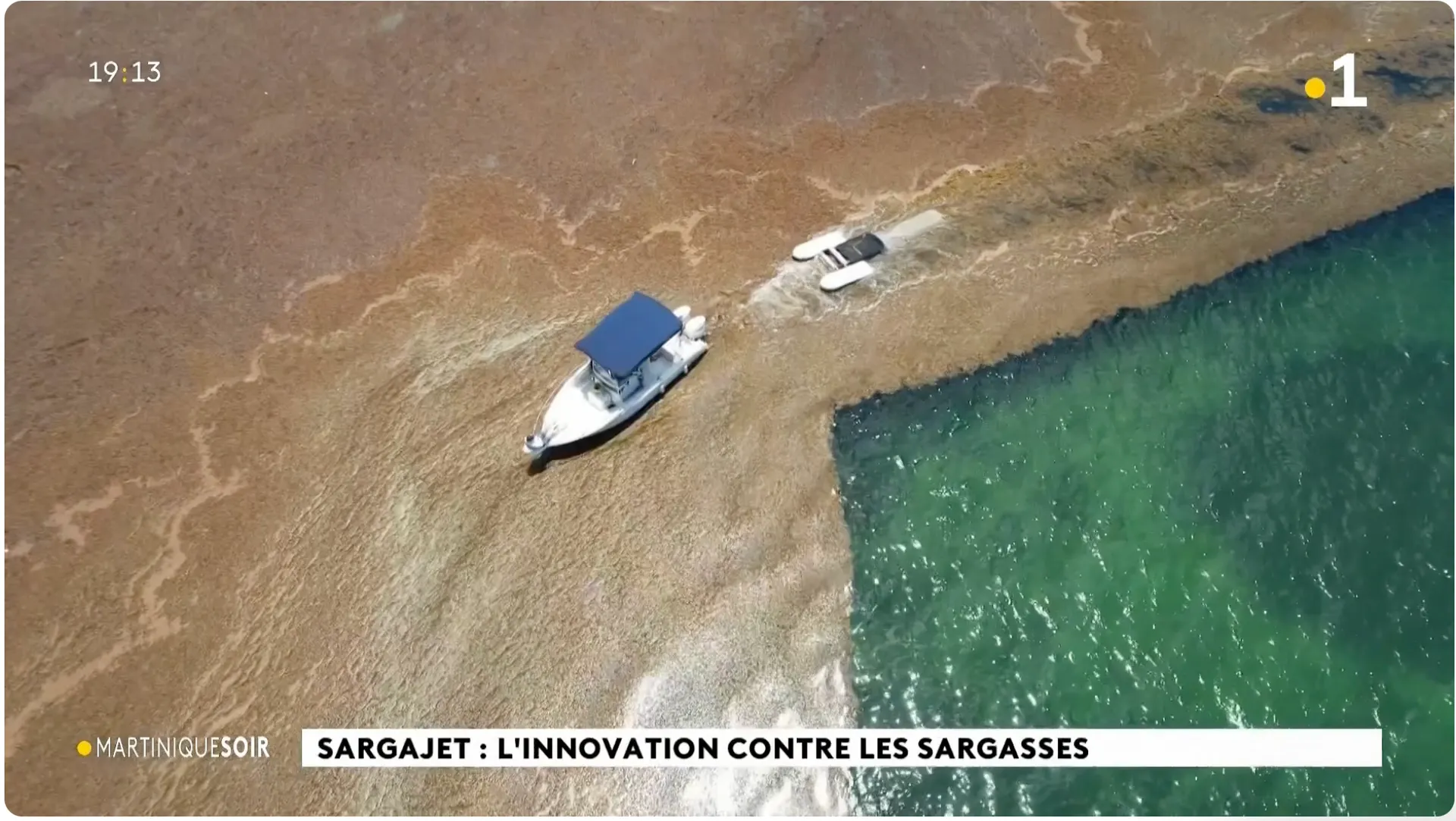
SargaJet is an innovative device developed locally by the startup Sargawatt. It was designed to address a major challenge in Martinique: collecting sargassum directly at sea, before it washes ashore.
It consists of a small trawl towed by a boat, combined with a sequence of automatically released nets. The aim is to simplify collection operations and make fishermen’s work easier.
According to its designers, the system can currently collect up to 10 metric tons of sargassum using twenty 3 m³ nets.
Automatic nets to streamline collection
Timothée Pagès, a design engineer at Sargawatt, has been working on the concept behind SargaJet for several years.
The system is designed to keep collection going without constantly interrupting operations. When a net is full, the fisherman briefly accelerates to trigger its release. The net then closes, while the next one automatically moves into position.
The system can accommodate up to 20 nets per load. Its lightweight design means several units can be carried aboard a boat, making it easier to switch between them.
The ambition is clear: to make collection simpler, more continuous and more effective in the field.
A low-cost system to expand collection capacity
In addition to its automatic operation, SargaJet is presented as an affordable option. Rather than relying on a single high-capacity unit, Sargawatt is considering deploying several units that can work simultaneously.
This approach could make it possible to adapt collection resources to the needs of different territories and the volumes of sargassum present at sea.
The device’s performance, operating costs and suitability for existing sargassum response operations still need to be assessed on a larger scale.
Sargawatt targets new markets
Sargawatt does not intend to limit its innovation to Martinique. The company aims to develop its solutions in French territories first, before deploying them more widely across the Caribbean.
The company has already begun discussions with partners in the region, particularly in the Dominican Republic, where sargassum strandings are also a concern for businesses.
This would be a revolution for communities severely affected by sargassum and for coastal tourism businesses, for which collecting the seaweed before it reaches beaches is particularly important.
SargaJet, SargaMap and SargaDry: three complementary tools to tackle sargassum
Founded in late 2022, Sargawatt is also developing two other solutions to address different stages of the problem.
• SargaMap: a mapping tool designed to locate sargassum and anticipate strandings.
• SargaDry: a solution designed for the conditioning and valorization of collected seaweed.
Together with SargaJet, these two tools are part of the same strategy: better anticipating sargassum arrivals, making collection easier and exploring ways to put the biomass to use.
At this stage, the capabilities described by the device’s designers point to promising potential. However, collecting sargassum at sea alone cannot resolve all the difficulties associated with it. The device’s effectiveness will depend in particular on operating conditions, the volumes of seaweed to be handled and coordination with other response measures.
Source: Martinique la 1ère — article and video report, October 23, 2026 (in French).