Emmanuel de Reynal — Laisse-moi te dire — October 7, 2026. English translation by Sargawatt.
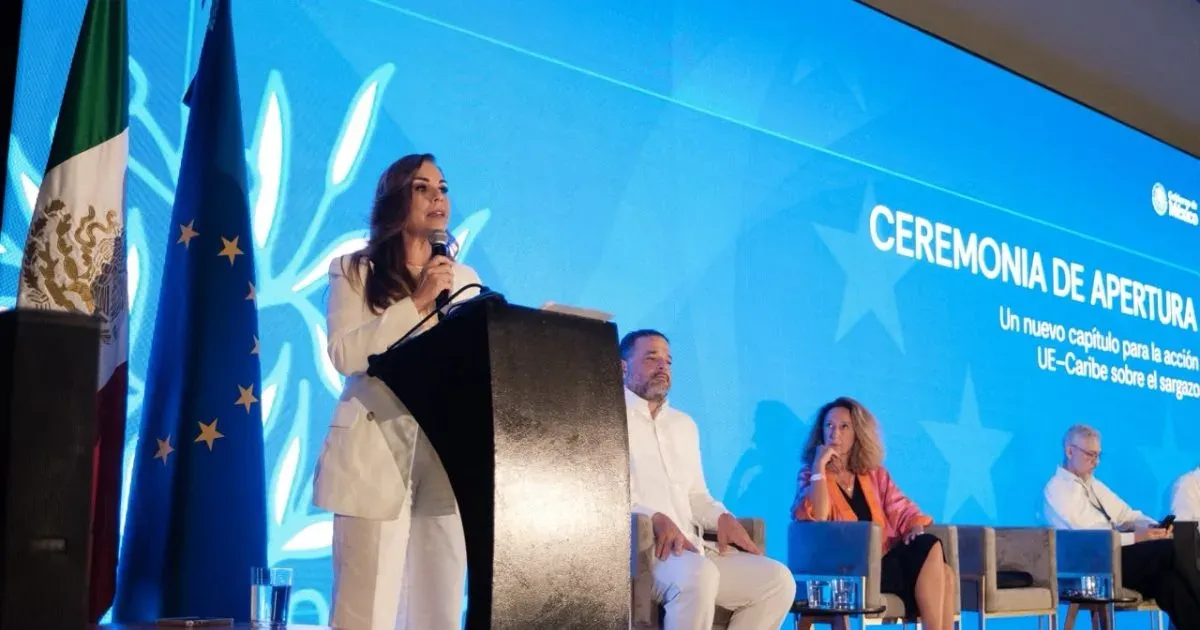
Matthieu Bergot, CEO of Sargawatt, was in Cancún to take part in the major international symposium on sargassum.
What lessons can Martinique and Guadeloupe take from the Global Gateway event in Cancún, “Shaping a Caribbean Sargassum Value Chain”?
First, the profound influence of history and geography becomes apparent, with implications for a strategy spanning several territories. Creating this sustainable sargassum value chain in the Lesser Antilles therefore remains an ambitious but necessary goal.
Seven realities about sargassum in Mexico immediately stand out:
• Distance shaped by centuries of history: Cancún and Mexico’s Caribbean coast have limited transport connections with our territories, and reaching them currently takes more than 30 hours, including stopovers. From Fort-de-France, it is quicker to reach Rio, Los Angeles or even Tokyo. If we are going to invest that much travel time, it might even be more useful in some respects to study Japan’s expertise, rooted in a centuries-old tradition of harvesting and making use of seaweed.
• The volume of sargassum to be handled in Mexico reaches record levels, on a scale at least 100 times greater than in our territories.
• The land available for removing, storing or drying sargassum is on an entirely different scale from that of our territories, all within a single country connected by fast road and rail networks.
• Water restrictions are unheard of in Cancún, whereas island territories sometimes suffer from drought or inadequate water distribution networks.
• Mexico pools its resources for tackling sargassum, including the Mexican Navy and state involvement backed by enormous budgets. Although the French territories set spending records per kilometer of affected coastline, Mexico’s overall resources—booms, boats, labor and processing facilities—are on a completely different scale from those of islands the size of the Lesser Antilles.
• The hotel sector is enormous, supported by vast beaches and natural areas, making sargassum an existential threat to these businesses.
• Environmental and regulatory standards are much less restrictive than in French territories, and in some cases are virtually nonexistent in Mexico, for example concerning arsenic removal.
So, does Mexico have nothing in common with our territories? Of course it does. We have much to learn from Mexico, as from every other country in the region: successes and failures in forecasting, collection and valorization techniques; strategies for coordinating hotels and public action; and visions for the future, including collection on the open sea. The wish expressed at the end of Global Gateway by Myriam Ferrán, the representative from Brussels, which co-organized the event with Mexico, makes sense: she called for a single Caribbean entity to coordinate the overall approach and give a sustainable value chain the best chance of emerging.
Nevertheless, the Caribbean islands—at least those of the Lesser Antilles—often face their own specific circumstances and constraints:
• volumes of sargassum per territory that are, all things considered, often too small to support industrial valorization on a profitable scale;
• often densely populated island communities close to stranding sites;
• limited available land;
• often severely constrained financial resources: hotels could contribute, but there are far fewer than in Mexico to finance operations; populations are often poor, and governments have limited resources;
• the need to preserve water resources;
• and demanding environmental expectations. The trauma caused by chlordecone is a warning against repeating the same mistakes with the heavy metals contained in sargassum. This constraint is actually an asset for the future: ultimately, nobody will want to buy a bio-based product whose raw material pollutes the environment.
This highly specific Caribbean island context is also a strategic asset. France holds a degree of leadership in tackling sargassum in island territories. That experience can offer particularly relevant benefits to the Caribbean islands, enabling our territories to develop and export real expertise, supported by suitable logistics and organization. Martinique’s expertise in containment booms is already being exported elsewhere—for example, to Antigua by Filet DROM. This is an encouraging sign, to be complemented by collection and valorization solutions that can help build this much-discussed value chain in island territories. The medium-term economic opportunity offered by sargassum should not be overlooked. It could create jobs in our territories, and without a sustainable value chain there will be no viable solution. To suit the Caribbean island context described above, an offering must be developed that is “low cost, sustainable and scalable.” This is what Sargawatt is pursuing through forecasting, optimized boom positioning, collection at sea and sargassum stabilization: the first steps needed for other operators to build a credible processing industry. The winners of the French National Research Agency’s Sargassum III call for projects, in partnership with ADEME, also provide an avenue for regional companies to excel in sargassum valorization. A Martinique-based company, Emerwall, is already developing bio-based products made from sargassum locally. All this momentum deserves encouragement and coordination across the Caribbean islands. As the problem continues to grow, this is an investment in the future, provided priority is given to “low cost, sustainable and scalable” approaches—the only ones capable of creating a lasting business model for these territories.
Matthieu Bergot, Sargawatt
Read the original publication on Laisse-moi te dire (in French).