Emmanuel de Reynal — Laisse-moi te dire — October 2, 2026
Originally published on Laisse-moi te dire, reproduced with the author’s permission. English translation by Sargawatt.
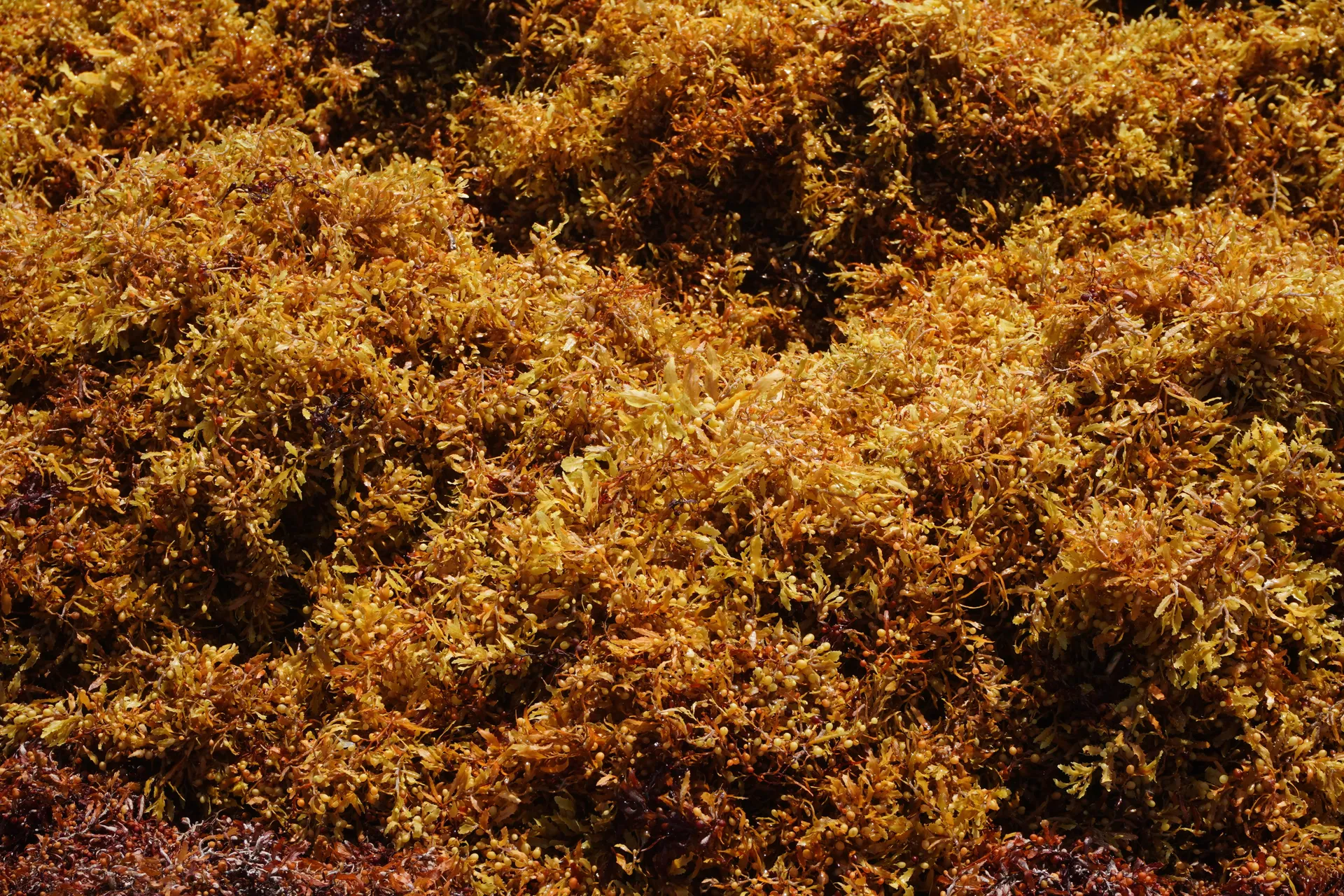
For around fifteen years, sargassum has become part of our landscape. What once seemed exceptional has now become a recurring reality that we must learn to live with. Large-scale strandings have affected Martinique since 2011, bringing health, environmental and economic challenges.
We know the consequences: beaches covered in seaweed, unpleasant odors, and difficulties for residents, fishermen, tourism businesses and local authorities. As stranded sargassum decomposes, it releases hydrogen sulfide and ammonia, with potential health effects for people exposed to them.
Until now, our main concern has been getting rid of this seaweed. Sargawatt, a young company from Martinique, aims to enable this biomass to be put to use through a sustainable business model that does not depend on subsidies. To achieve this, Sargawatt is focusing on the first link in the value chain: collection. The aim is to supply quality sargassum in volume and at lower cost to downstream operators. In other words, to innovate and create value in a field where Martinique already holds a real leadership position in the Caribbean. We should acknowledge the public and private organizations that have been working on this for many years and have achieved undeniable results.
From reaction to anticipation
Sargawatt is a young company based in Fort-de-France. Its project relies on three complementary tools: SargaMap to forecast and locate incoming sargassum, SargaJet to collect it at sea, and SargaDry to stabilize it for industrial valorization.
SargaMap aims first to provide a more precise picture of where sargassum rafts are located, how they move and which areas may be affected. This forecasting capability can help organize collection more effectively and optimize the placement of containment booms, improving their effectiveness and reducing their cost.
Next comes SargaJet, arguably the most striking part of the system. Rather than waiting for the seaweed to reach the coast, where it becomes difficult and expensive to remove, the system aims to intervene at sea. Towed by a conventional boat, it is protected by four patents. It collects large volumes of sargassum at lower cost before onward transport. According to trials carried out by the company, the technology could reduce the total cost of collection by up to 50% compared with reference systems, including both investment and operating costs. The equipment is also highly mobile: SargaJet, essentially a floating trailer, can be moved quickly by land or sea between collection sites. It can be dismantled and shipped by sea or air in IKEA-style flat-pack boxes. Designed with environmental considerations in mind, it emits fewer greenhouse gases per metric ton of sargassum collected than existing systems.
The project has already moved beyond the concept stage. Several generations of prototypes have been developed and tested, particularly in Martinique, and SargaJet has now entered an initial commercial phase. The company is already taking part in local operations linked to a public sargassum collection contract. A new generation of SargaJets is being prepared for the 2027 collection season.
What if sargassum could also become a raw material?
This is the second dimension of the project, and perhaps the most promising in the longer term.
Sargassum collected after several days of decomposition is a troublesome waste. Biomass collected at sea, better preserved and then properly stabilized, could instead be of interest to industrial companies.
This is the role envisaged for SargaDry: enabling the production of biomass that can be stored and transported. Ways of putting sargassum to use are being explored worldwide in fields including biogas, biofuels, sustainable aviation fuel (SAF), biochar, cement, fire-resistant insulating panels, acoustic panels, bioplastics, and the extraction of compounds of interest for chemicals and cosmetics. Sargawatt is already in contact with laboratories and companies in Martinique and elsewhere working on these applications.
We must remain cautious and patient: the sargassum value chain is still taking shape. Collection and valorization will need to advance together in the years ahead. Sargawatt’s role lies primarily upstream in this emerging economy: making a low-cost raw material available in quantity, while respecting the environment, for others to process.
In other words, before sargassum can be turned into valuable products, it must first be possible to supply it in large volumes, regularly and at minimal cost. This is the bottleneck Sargawatt aims to overcome.
Innovation rooted in Martinique
A source of local pride! The company is headquartered in Fort-de-France. Martinique and Guadeloupe are its first operating grounds, ahead of planned expansion across the rest of the Caribbean. This involves developing the local logistics needed to manufacture, assemble, test and deploy the equipment, creating new local jobs in the process.
This local connection is embodied by Bruno Sainte-Rose, the company’s co-founder and chief technology officer. Originally from Martinique, Bruno is a Centrale Paris-trained engineer with a doctorate in fluid mechanics. His experience relates directly to the drift and collection of floating objects, including work with The Ocean Cleanup. Matthieu Bergot, Sargawatt’s founder and president, also knows the region well after around fifteen years of professional activity in the French West Indies and French Guiana, including ten years living there.
Their approach is interesting because it reverses a pattern we know all too well: waiting for a solution devised elsewhere to reach us. Here, the problem is Caribbean, the testing ground is Martinique, and part of the technological response is being developed locally.
Sargawatt has also been recognized under France’s Jeune Entreprise Innovante scheme, distinguished by Solar Impulse, and included in the Cluster Maritime Français’s 2026 Blue Tech Index as one of France’s 40 most promising blue-tech companies that year. Its development also benefits from France 2030 support.
Turning our constraints into expertise
We often discuss the constraints we face: island geography, a small market, remoteness, and exposure to natural or environmental risks. These constraints are real. But some can also become opportunities for innovation. Sargassum is a perfect example.
We are among the first to be affected by this phenomenon. Let us therefore be among the first to invent the technologies, professions and business models needed to address it. If technology developed in Martinique can then be used in Guadeloupe, Mexico, elsewhere in the Caribbean, or even to tackle other invasive aquatic plants in Europe, we will have turned a local nuisance into exportable expertise.
This is the entrepreneurial spirit from Martinique that deserves encouragement: seeing a problem both for what it costs us and for what it pushes us to invent.
Sargawatt is still a young company, and much remains to be demonstrated at industrial scale. Its own leaders acknowledge this. Yet the approach already conveys a powerful idea: sargassum will not disappear tomorrow. We must therefore learn to forecast it better, collect it more effectively and, wherever technically and environmentally feasible, process it.
From scourge to resource. Turning a problem endured in the Caribbean into innovation developed in the Caribbean. This is how the most inspiring entrepreneurial journeys begin.
Long live Sargawatt!
Read the original publication on Laisse-moi te dire (in French).